Customized Training for the Career You Want
We focus on individualized learning and career planning, including frequent and formative feedback, ongoing faculty and peer mentorship, and dedicated curricular time.
Our program’s dedicated educators spanning disciplines, specialties and training sites support fellows’ growth, amplify your strengths, and prepare you for a personally meaningful and impactful career.
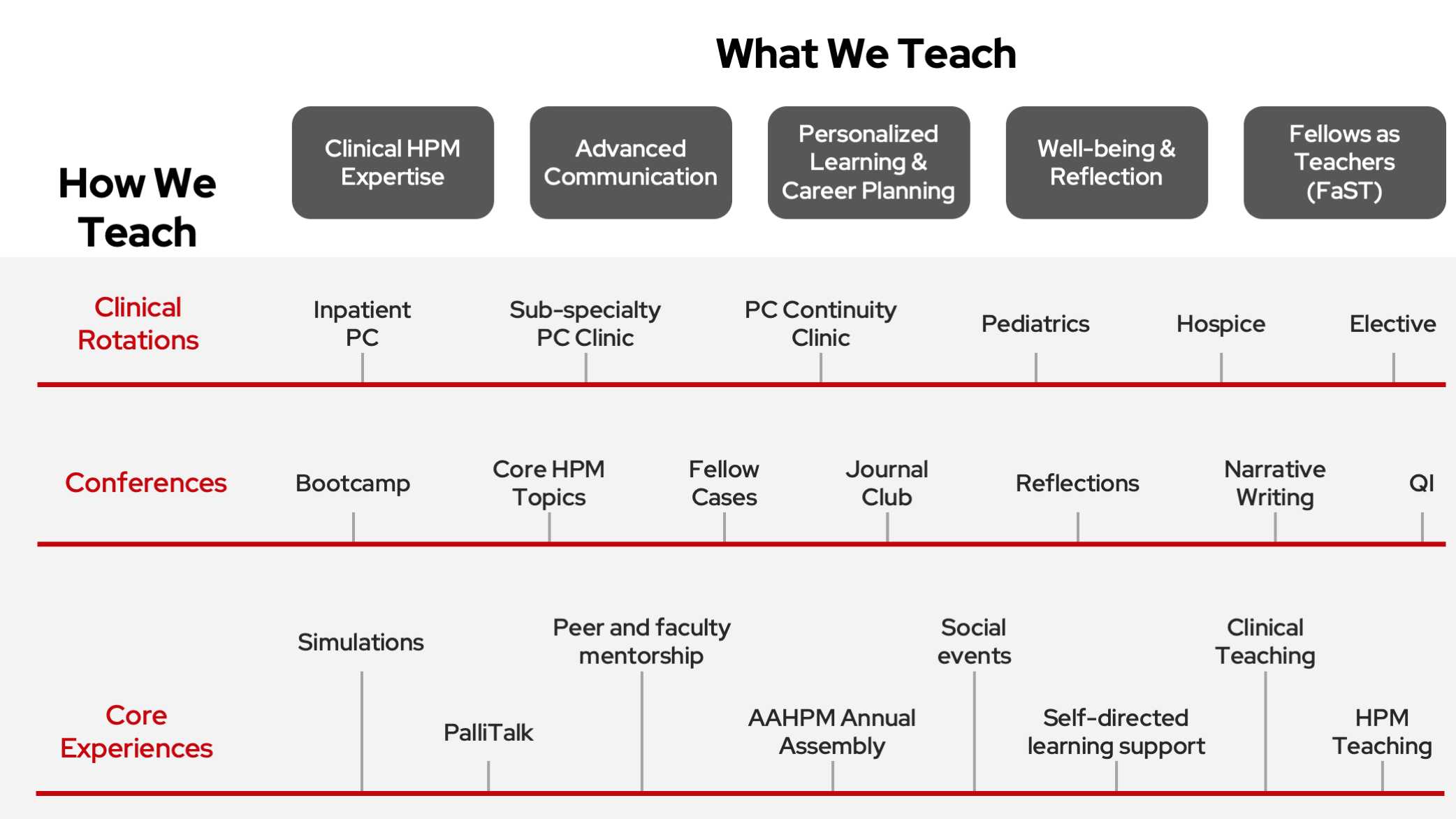
The curriculum is built around five curricular threads: clinical hospice and palliative medicine (HPM) expertise, advanced communication, personalized learning and career planning, well‑being and reflection, and Fellows-as-Teachers. To ensure fellows grow not only as specialty experts but also as communicators, educators, teammates and intentional physicians, these core areas are woven across a comprehensive set of educational experiences:
- Clinical Rotations — Build and apply HPM clinical skills during high‑impact experiences across multiple sites, settings and illnesses.
- Conferences — July Bootcamp, core HPM teaching, fellow case discussions, journal club, reflection conferences, narrative writing and QI sessions.
- Core Experiences — Simulation trainings, PalliTalk regional communication workshop, structured mentorship for professional development, national meeting attendance, social events, self‑directed learning support, and teaching tools for clinical and group settings.
- Growth mindset for life-long, self-directed learning in the vast field of HPM.
Didactic Experiences
Fellowship kicks off with a bootcamp that includes concentrated group learning sessions interspersed with your first clinical rotations to apply these foundational concepts. In addition to introducing our program and people, fellows gain core knowledge and skills in palliative care consultation, hospice eligibility and logistics, communication skills, opioids, symptom management and interprofessional collaboration.
Throughout the fellowship, education is a top priority, with protected education time each week for fellow learning in our comprehensive conference curriculum and to deepen learning and foster community across our program. Fellows are key educators over the year as well, honing effective teaching skills while also contributing to co-fellows’ and our team’s knowledge.
Clinical Experiences
Our two‑week clinical rotation blocks promote flexibility and fellow well-being by balancing varied clinical environments, standardizing Monday start dates, fulfilling specific dates for time off and supporting a sustainable rhythm of learning.
Sample Rotation Schedule
| July/Aug/Sept/Oct | Nov/Dec/Jan/Feb | March/April/May/June |
|---|---|---|
| UW Palliative Care Inpt | UW Palliative Care Inpt | UW Palliative Care Inpt |
| Agrace Hospice* | Agrace Hospice* | Agrace Hospice* |
| UW Consults | UW Consults | UW Consults |
| Agrace Hospice* | Agrace Hospice* | Agrace Hospice* |
| UW Palliative Care Inpt | UW Palliative Care Inpt | UW Palliative Care Inpt |
| UW Consults | Elective* | Elective* |
| VA Consults | VA Consults | VA Consults |
| Subspecialty Ambulatory Palliative Care* | Peds Palliative Care | Subspecialty Ambulatory Palliative Care* |
| – | – | UW PC Capstone (IPU or consults) |
| – | – | VA Consults |
| *Continuity PC Clinic (during Agrace, Subspec and Elective rotations) | ||
- UW Inpatient Palliative Care. A cornerstone learning experience as a member of patients’ primary inpatient team to become adept at symptom-management and interprofessional holistic care. Guide patients and families through complex transitions of care and end-of-life experiences, and provide consultation for oncology, hematology and bone marrow transplant patients.
- Agrace Hospice. Fellows experience hospice care across home, facility, memory care, and inpatient hospice settings, learning eligibility assessment, symptom management, and hospice regulatory knowledge with a local non-profit hospice agency.
- UW Palliative Care Consult Service. Develop clinical mastery with exposure to a wide variety of subspecialized medical and surgical teams caring for patients with complex illnesses including advanced heart failure, complex genetic syndromes, high-level trauma and solid organ transplantation.
- VA Palliative Care Consults. Gain experience caring for veterans with serious illness, focusing on comprehensive assessment, communication, and system navigation within the Veterans Affairs (VA) healthcare system.
- Electives. Electives are an opportunity for fellows to tailor their learning goals and explore their emerging professional identity. Examples of prior elective topics: radiation oncology, geriatrics, humanities and ethical principles in medicine, burn and wound care, dignity therapy, and medical education.
- Subspecialty Ambulatory Palliative Care. Fellows deepen their symptom-management toolkit and illness-specific knowledge by attending palliative care subspecialty clinics, Pain Medicine clinic, and Home-Based Primary Care visits.
- Pediatric Palliative Care. Work with a robust interprofessional pediatric palliative team at American Family Children’s Hospital, providing care for children with complex, serious illnesses and their families. This experience includes consults, interdisciplinary rounds for pediatric hospice patients, child‑life collaboration, and exposure to bereavement and legacy work.
- Continuity Clinics. Our X+Y model means that during inpatient rotations fellows are focused on that clinical work; then, during outpatient rotation blocks, fellows attend 1.5 days of continuity clinic weekly: one full day at UW Palliative Care Clinic and a half day at VA Palliative Care Clinic.
Scholarly Activity
Teaching
Our learners are also teachers. We developed a unique Fellows as Teachers curriculum to grow our field and train the next generation of HPM educators.
We also offer an option for a second year focused on medical education and leadership.
Educator Development
The Department of Medicine's Fellow Medical Education (FAME) Training Track trains fellows to become effective clinician-teachers and scholars.
QI and Research
All of our fellows participate in a faculty-supported QI curriculum and project, and present at the UW Health QI Symposium.
If you are interested in research, there are opportunities to partner with faculty. You can also continue your scholarly work through an optional second-year VA Advanced Fellowship in Geriatrics.
Additional Opportunities in the Department
- QI Curriculum for Fellowship. Teaches fellows how to apply quality improvement knowledge and skills directly to clinical practice—and ultimately improve patient care.