Virtual eye screening for safer hydroxychloroquine use in lupus
First-of-its-kind study applies a proven telehealth approach from diabetes care
For people with lupus, hydroxychloroquine (HCQ) helps reduce disease flares, kidney damage, and mortality.
However, the small risk of permanent eye damage associated with HCQ means that people who take it must have a baseline eye exam and ongoing retinal screening to ensure safe use.
But only half of lupus patients take HCQ as prescribed, and only half of those receive the required eye screening.
Now, Christie M. Bartels, MD, MS, professor and division chief, Rheumatology, is leading a study that adapts telehealth solutions from diabetes care to bring eye screening to lupus patients.
If successful, the approach—the first of its kind in rheumatology—may significantly improve screening rates, patient safety and adherence to HCQ.
A persistent access gap
To better address these problems, Dr. Bartels and colleagues launched a pragmatic study, “Virtual Visual Screening to Address Safe Hydroxychloroquine Use in Lupus (ViSTASafe HCQ.”
It takes place at four sites: Froedtert Specialty Clinics–Medical College of Wisconsin (Milwaukee), UW Health Eastpark and UW Health Junction Road (both in Madison), and Grady Health (Atlanta).
The research team first examined baseline HCQ eye screening rates at the four sites. They found that overall, 48 percent of lupus patients did not have any documented annual eye screening, and that this gap was more common among patients with prior Medicaid eligibility and those living in socioeconomically disadvantaged areas.
Their findings—presented on November 8, 2026, as an abstract at the American College of Rheumatology 2026 annual meeting—highlight challenges that lupus patients encounter in routine care.
For example, patients may struggle to secure appointments, travel to ophthalmology clinics, or navigate multiple visits for different tests. Others may delay or discontinue HCQ because of concerns about eye damage or difficulties completing required monitoring.
Adapting a proven telehealth model
To bridge these gaps, Dr. Bartels looked to a model that had successfully improved screening rates in another chronic disease: diabetic eye care. She and her collaborators saw an opportunity to adapt a similar telehealth model for lupus patients.
After extensive stakeholder engagement and workflow design efforts, they developed a screening protocol that staff could administer right in the clinic.
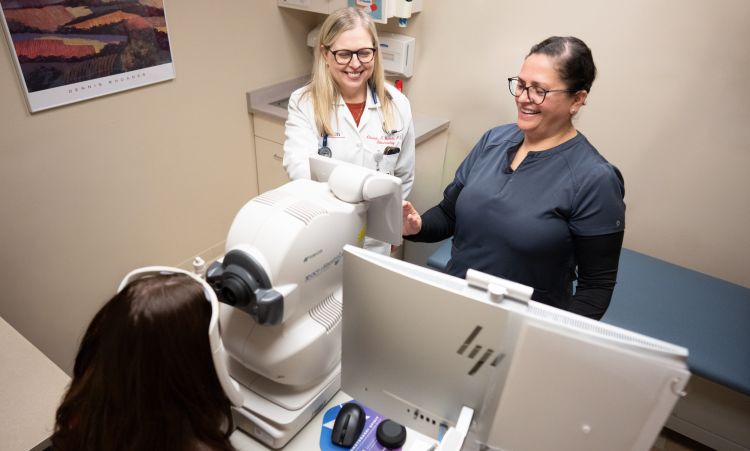
Trained medical assistants first use a touch-focus optical coherence tomography (OCT) camera to capture a patient’s retinal images. The patient then uses a self-guided, virtual reality-based headset to complete a visual field test.
The entire screening takes about 10 to 20 minutes.
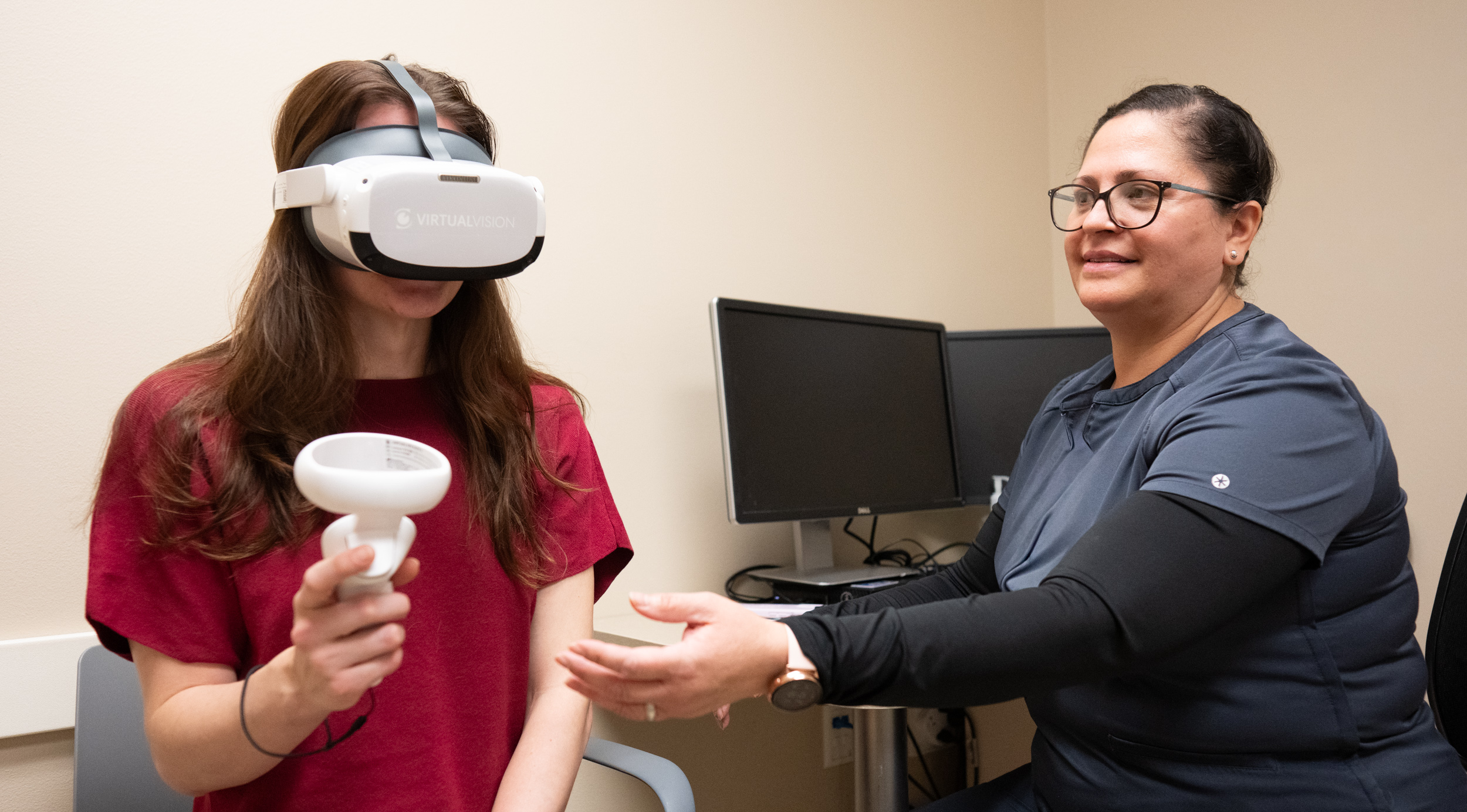
The images and test results are then electronically transmitted to in-system optometrists, who asynchronously interpret the findings and return a report through the electronic health record.
The rheumatology team tracks the results over time and refers any patients with abnormal findings for a traditional in-person eye examination.
“The imaging equipment is portable—we can keep it on a mobile cart and move it into clinic rooms as needed,” Dr. Bartels said. “Even the VR headset for the visual field tests self-narrates in 20 different languages.”
“It’s far more accessible to bring imaging technology to the patient instead of expecting patients to go to the technology,” she continued.
Building a model for broader adoption
The research team is also studying whether this intervention is feasible in routine clinical practice and acceptable to both patients and staff. If so, it may offer a scalable model for academic health systems and lupus clinics nationwide.
Dr. Bartels believes those benefits could extend beyond screening alone.
If eye screening and HCQ adherence improve, then [lupus] can be well controlled. This is just one barrier we can remove from the chronic disease burden.
Dr. Christie Bartels
“We would love to see if this intervention improves screening rates, but it might also improve HCQ adherence because patients would know that they're still in the safe zone to continue to use this life-saving medication,” Dr. Bartels explained.
“We're hoping that the high tide will raise all ships,” she continued. “If eye screening and HCQ adherence improve, then the disease can be well controlled. This is just one barrier we can remove from the chronic disease burden.”
--
Acknowledgements
Dr. Bartels acknowledges the contributions of many project partners in rheumatology, optometry, ophthalmology, nursing, clinical research operations, and patient advocacy. Specific contributors include:
- Janet Cushing, OD, and Roomasa Channa, MD (both from the University of Wisconsin Department of Ophthalmology and Visual Sciences);
- Wendy Rodgers, MEd, MPH, Director, Care and Support Services at the Lupus Foundation of America, who served as the project’s patient expert; and
- Many dedicated implementation and research staff at participating institutions.
The Defense Health Agency Contracting Activity, 808 Schreider Street, Fort Detrick MD 21702-5014 is the awarding and administering acquisition office.
This work was supported by the U.S. Department of Defense, in the amount of $2,412,488, through the Congressionally Directed Medical Research Programs under Award No. HT9425-24-1-0877. Opinions, interpretations, conclusions, and recommendations are those of the author and are not necessarily endorsed by the U.S. Department of Defense.