Dr. Fahad Aziz and the healing art of connecting with patients
Practical lessons for clinicians at all career stages
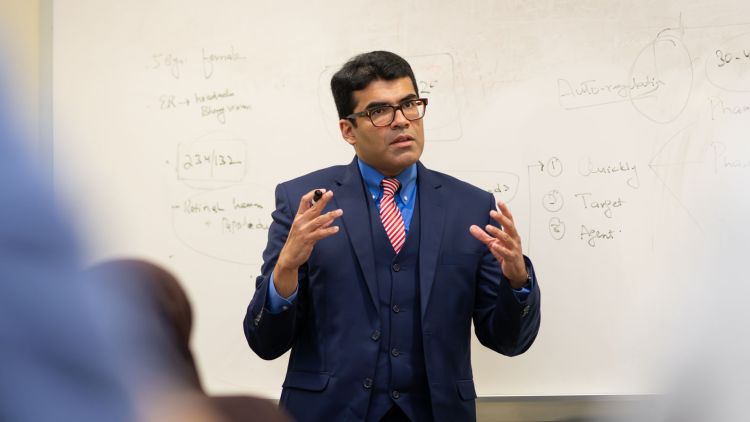
Fahad Aziz, MD, Flesch Family Fellow in Kidney Transplant Research and division chief, Nephrology, is the co-author of five books focused on kidney transplantation and leadership in early academic medicine. In his sixth and most recent book—his first as a solo author—he takes a new and deeply personal direction.
In The Healing Art of Connecting with Patients, Dr. Aziz returns to his creative writing roots, first formed during medical school, to share powerful stories that illuminate the practical importance of compassion, presence, and human connection in medicine.
These narratives offer lessons that can resonate across specialties and career stages, reminding clinicians that meaningful healing begins with connection.
Learn more in the Q&A below.
Why did you write this book?
There’s a story in the book, in the chapter on compassion, about a bus accident. Many patients were rushed into the hospital all at once. Years later—five or six years afterward—someone went back and interviewed those survivors. What stayed with them wasn’t the medications or the procedures. They remembered two things: the pain they felt…and the coldness they experienced from the people caring for them. The doctors did their jobs well. Lives were saved. And yet, something deeply human was missed.
I wrote this book as a reminder—to myself as much as to anyone else—that we cannot truly heal someone unless we first connect with them. Medicine isn’t just about what we do to patients; it’s about how we show up for them. When we slow down, listen, and allow ourselves to be present, healing becomes something deeper than treatment. It becomes human again.
Who is it for?
I wrote this book for clinicians who feel disconnected or burned out—those who still care deeply but feel far away from the reason they chose medicine in the first place. Burnout isn’t just about long hours or fatigue; it’s about losing touch with meaning. I hope this book helps reignite that sense of purpose by reminding us that healing begins with connection.
Why use stories as a guide and teaching tool?
I use stories because that’s how we truly learn and remember. Even in medical school, I was drawn to writing short stories, and I came to understand their power. We listen to stories in a way we don’t listen to lectures. Stories allow us to feel, to recognize ourselves in the details, and to connect on a human level.
When we connect emotionally, the lesson stays with us—and that’s where real change begins.
I wrote this book for clinicians who feel disconnected or burned out—those who still care deeply but feel far from the reason they chose medicine in the first place.
Dr. Aziz
And how did you approach the stories in it—did you look for them or did they "find" you?
It was really a combination of both. Some of the stories stayed with me for years—stories I first encountered long before I ever became a physician. I still remember reading about Florence Nightingale during the Crimean War in a seventh-grade textbook. That story never left me.
As I learned more about her life and work, I began to notice similar stories everywhere. Different eras, different settings—but the same core truth. The world changes, technology advances, medicine becomes more complex, yet the fundamental principles remain unchanged. At its heart, medicine is still about connection.
I saw that clearly during the COVID-19 pandemic, when despite all our machines and protocols, what mattered most was presence, compassion, and human connection. In many ways, once I started paying attention, the stories didn’t just come to me—I realized they had been there all along.
Is there a reason this is your sixth book and not your first? A reason you’re writing it now?
Absolutely. I don’t think I could have written this book earlier. It took time to grow into it. I began my medical training in 1999, and over the last 27 years, I’ve lived through countless transitions—from medical school to residency, fellowship, and beyond. With each stage, my goals and my understanding of medicine changed.
Along the way, I started to truly see that every patient carries a story. Watching a young person die in the ICU, standing at bedsides where life suddenly shifts—that kind of experience stays with us. It changes us, and it ignites something deeper than training ever could.
I also write about being on both sides of the doctor–patient relationship. Those experiences gave me a perspective I didn’t have earlier in my career. This book could only be written now, at this moment, when experience, reflection, and purpose finally came together.
I don’t think I could have written this book earlier...It could only be written now, at this moment, when experience, reflection, and purpose finally came together.
Dr. Aziz
What's one lesson you learned while writing it?
One lesson I learned is that honesty alone is not enough. As physicians, we often pride ourselves on being direct and transparent—but in doing so, we can sometimes forget to show patients a path forward.
When we tell someone they have cancer, or kidney failure, or a life-changing diagnosis, we’re not just sharing information—we’re shaking the foundation of their life. If honesty isn’t wrapped in hope, it can feel devastating. What patients need to hear is: Yes, this is real—but you are not alone, and there is a way forward.
That realization is why the book ends with a chapter on hope. Because healing isn’t just about telling the truth—it’s about helping people believe they can survive it.
And what’s something you hope Department of Medicine readers—whether they’re trainees or senior faculty—will take away?
I hope they take away that patient connection is intentional—it doesn’t happen by accident. The thirty minutes we spend with a patient may feel routine to us, but for that patient it could be the most important thirty minutes of their day, their week, or even their life.
If we can learn to slow down and be fully present in those moments, it changes everything. It makes a difference not only for our patients, but for us as clinicians as well—because that sense of connection is often what brings meaning back into our work.