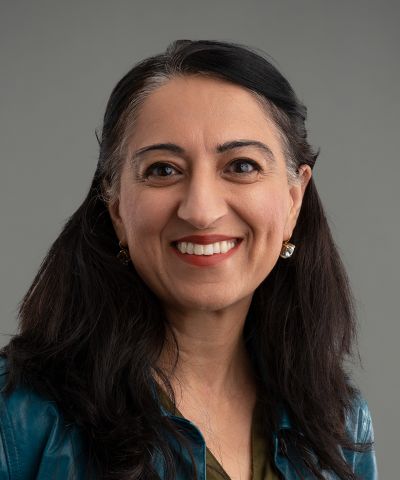
Nasia Safdar, MD, PhD
Professor
610 Walnut St
Madison WI 53726-2336
Madison WI 53726-2336
(608) 263-1545
Dr. Nasia Safdar is the Dr. Dennis G. Maki Endowed Faculty Fellow in the Division of Infectious Disease within the Department of Medicine and the associate dean for clinical trials at the University of Wisconsin School of Medicine and Public Health. She also holds affiliate appointments in the Department of Medicine's Division of Geriatrics, the Department of Population Health and the UW College of Engineering's Department of Industrial and Systems Engineering.
Dr. Safdar leads the department in its mission to reduce healthcare-associated infections by identifying, testing, and implementing novel interventions to reduce and prevent healthcare-associated infections (HAI). Her laboratory research focuses on the billions of microorganisms that live on and within the human body and that make up the microbiome.
Dr. Safdar is a 2017 recipient of a President’s Early Career Award for Scientists and Engineers (PECASE), the highest honor bestowed by the U.S. government on outstanding scientists and engineers beginning their independent careers. She also received the 2014 John Q. Sherman Award for Excellence in Patient Engagement and the 2019 Oswald Avery Award for Early Achievement that honors ISDA fellows age 45 or younger for overall outstanding achievements in infectious disease.
Dr. Safdar became an invited fellow of the Alpha Omega Alpha Honor Medical Society in 2021 and an American Society for Microbiology Distinguished Lecturer in 2023. Dr. Safdar is the 2027 recipient of the Wisconsin Medical Alumni Association Resident/Fellow Citation Award, the highest honor awarded by WMAA for a distinguished career.
Dr. Safdar is a Fellow of the American College of Physicians, a fellow of IDSA and a fellow of SHEA.
Dr. Safdar’s clinical focus is on healthcare-associated infections, particularly in the acute care setting.
View Dr. Nasia Safdar’s Publications on NCBI My Bibliography
Dr. Safdar’s research broadly focuses on efficacy of novel interventions to prevent and reduce healthcare-associated infection such as the use of probiotics for reducing colonization by methicillin-resistant Staphylococcus aureus and Clostridium difficile and she has ongoing clinical trials in this area.
She leads the fecal bacteriotherapy program at UW Hospital and is the principal investigator for a number of ongoing trials assessing fecal microbiota transplantation as an intervention to reduce HAI.
Dr. Safdar has received research funding through the Department of Veterans Affairs, the University of Wisconsin Partnership for the Future Program, the Wisconsin Women’s Health Foundation, the John A. Hartford Foundation, the National Institute of Allergy and Infectious Diseases, the Agency for Healthcare Research and Quality, and as a scholar from the National Institute on Aging.