
Transthyretin Amyloid Cardiomyopathy Suspicion List
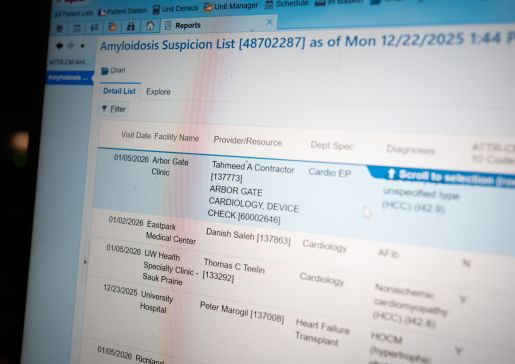
This report leverages all available data to prospectively identify and flag at-risk patients right in Health Link—so physicians can review their chart before they even arrive at the clinic.

The Challenge
Cardiovascular Medicine providers wanted to better identify patients who might have Transthyretin Amyloid Cardiomyopathy (ATTR-CM), a treatable but often misdiagnosed disease.
Previous approaches, such as using SlicerDicer to filter patients by diagnosis codes, were labor-intensive—and overlooked patients who were receiving other cardiology treatments but not yet formally diagnosed with this disease.
If providers had a way to adequately leverage all available data, they would have more opportunities for earlier diagnosis and intervention.
What We Discovered
We started with the idea of a registry, but realized that building a prospective tool for undiagnosed patients was a more complex problem.
The indicators for ATTR-CM were scattered across multiple EHR locations: diagnosis codes, procedure histories, laboratory results, imaging variables, medication orders, and clinical flags like pacemaker placement or AFib.
There was no single view to connect these dots in real-time, so clinicians were always working with incomplete or outdated information.
The Solution
- We designed a near-real-time HealthLink report that consolidates over 10 EHR data points into a single, actionable tool to identify diagnosed and at-risk patients.
- The report automatically combines diagnosis codes, clinical indicators, and critical contextual information like demographics, comorbidities, scheduled appointments, and treating providers—in one view, right in Health Link.
The Impact
- We didn’t stop at a static report. We built the foundation for an actionable system.
- The report also flags upcoming appointments with potentially high-risk patients.
- That means providers can click from the report directly into the patient's chart and proactively review and plan care.
With this system, providers can work from a more cohesive, targeted set of data—and act on it before patients even walk through the door.